
Paying the Mafia for the Right to Exist explains how bad actors charge street merchants for the right to work on the street, and how this works in one market.
Derecho del Suelo – Right to the Soil
In Mexico we have something called “derecho del suelo” which loosely translates as the “right to the ground or soil”. If you are thinking that this means somebody buys a piece of land and owns it, you are wrong. What this means is that somebody (mafia, cartels, or just the local government working ex-official) people who want to do some business “in their territory” have to pay them a set amount every time period (from hours to days to monthly) just in order for them to leave the merchant alone.
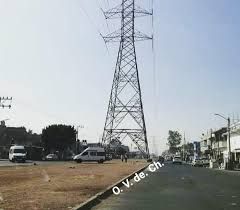
This is a photo of the same street on market days (Saturdays, Sundays, and a week before Christmas or New Years).
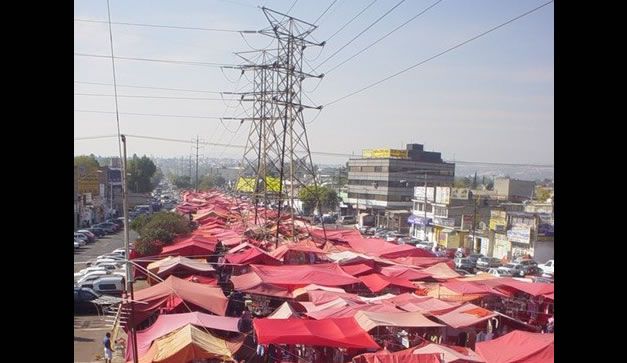
The difference is all the people who are selling and buying products under those red canvases.
So how does this work?
Very simply put, it is extortion. This is completely open and sanctioned by the federal government. Each one of those tents will pay the local politician somewhere around $20,000 USA DOLLARS (but in pesos) for the spot that he wants. At one end of this street under the power lines is a major road, and a minor road at the other end. As your spot gets closer to the major road it is more expensive. This spots that cost $20,000 dollars are for about 2 meters by 3 meters. That is about 7 feet by 10 feet. It is either pavement (the road) or dirt/concrete (the side walk or green area). That is to just get your spot on a market day morning. These run Saturday and Sundays and an extra week around Christmas and January 6 when the 3 wisemen arrive.
But that just gets you in the door. They have people who come around and charge each stand another $200 pesos (about $12 dollars) in the morning and in the evening. People who want to sell something “just on the side walk” can do so, but they pay a daily charge that is higher.
What you get for dirt
This transactions are by word of mouth. The merchant gets absolutely nothing other than the right to exist. Somebody moves in and takes your spot? The people who run these types of markets have nothing to say or will do nothing. They will tell the merchant to set up the next market day earlier, because somebody got your spot. Set up time is around 6 A.M.
I asked one merchant about what if somebody takes their spot, and he answered that he and the other merchants around him (they get to know each other over time) will just get sticks and chains and beat the interloper and drag his goods out into the open street when the cars are. That is how things are done here.
Who gets the money?
When I asked about who is behind these markets and who gets the money, it is not the federal government. It is not the local government. Usually the person in the position of being mayor over that market is the one who runs it clandestinely. That means they get into office through a political party, and the entire proceeds get divided up between that local politician (pocket money) and the political party. These are the spoils of war kind of. Nobody in the federal equivalent of our IRS every gets involved. That money is not taxed.
What happens when some merchant wants out or wants in?
This transactions are amazing. For a spot on a street 2 days a week of mere feet, this transactions can go into the 10,s of thousands of dollars. The merchant I talked with had 3 spots, and he had invested about $60,000 US dollars for them, beside paying for each spot once in the morning and again in the afternoon. The daily fare usually is around $12 each time so that is nothing in comparison. But at one point he bought his third spot and it ran him $20,000. They can likewise sell their spot. But there is never any paper signed, no official recognition, and other than the departing merchant telling his buddies around him that he is getting out, no official anything.
This is how the cartels get into this business. When somebody is there and refuses to pay, then the people getting stiffed look for a sicaro to beat the guy up. This is how these markets work.
Merchant Unions are powerful
While there is nothing official and the merchants do not want anything official because the Mexican IRS (Tesorería) does not charge them taxes, this is no shabby business model. There are literally thousands of these kinds of markets in Mexico. There are local markets that basically have the same products, but are in buildings and pay taxes. Every neighborhood has these markets somewhere near them, and the local markets don’t sell on these market days. The street markets have to have lower prices in order to beat the installed-in-a-building merchants, so that is where the stolen goods are fenced. These merchants in the street markets also have a lot of ingenious ways of making very similar or close products that they can pass off as the real thing. One market near where I lived at one time was known for their US imported jeans (but made in Mexico). All the labels were the same as their US counterparts. Aidas, and every name brand label you can think of, perfumes, etc. are all fabricated clandestinely in Mexico for these markets.
Since the federal government has basically taken a hands off attitude towards these merchants, anything goes. But over the years the movement that Lopez Obrador started was largely based in those street market merchants. So his party protects them highly. They are the backbone of his movement.
Within the Congress, the street merchants have powerful unions that have won many seats in the Mexican Congress, so this situation will not change anytime soon.
Paying the Mafia for the Right to Exist